 LUNEVON

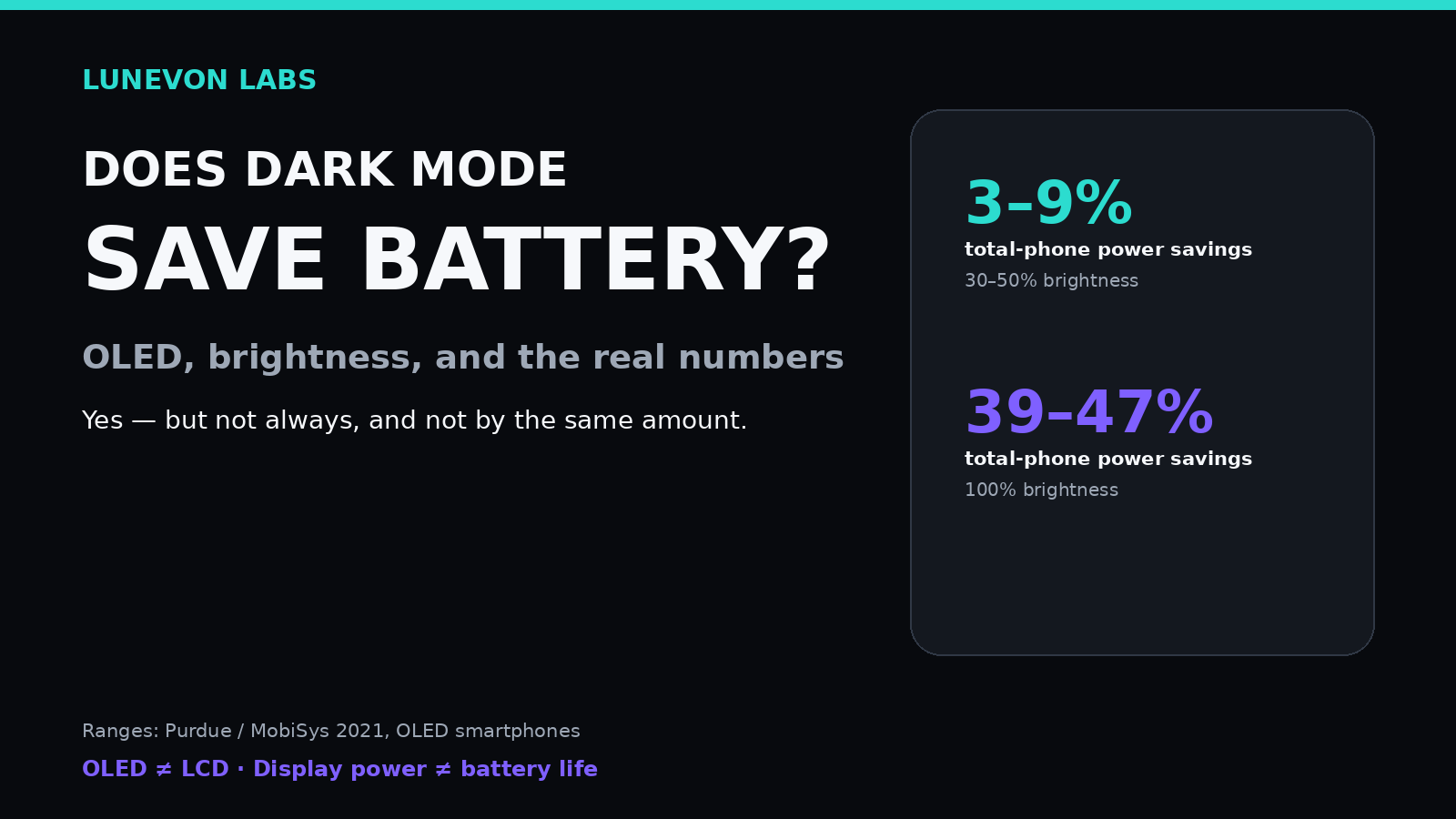
Short answer: yes — mainly on OLED. But the effect depends heavily on brightness, what is on the screen, and how much of the phone’s total power draw comes from the display at that moment. That is why a claim such as “dark mode saves X% battery” is usually incomplete without the test conditions.
LUNEVON LABS · Technical research
This work analyzes published measurements and technical sources. LUNEVON did not perform the Purdue measurements cited in the article.
Dark mode is often presented as a way to extend smartphone battery life. There is a physical basis for that claim: on OLED displays, darker pixels generally require less energy than bright pixels. Google lists reduced power usage as one of the benefits of dark theme and explicitly notes that the effect depends on the device’s screen technology.
That does not mean every phone with dark mode enabled will automatically last tens of percent longer.
In 2021, Purdue University researchers Pranab Dash and Y. Charlie Hu presented How Much Battery Does Dark Mode Save? at ACM MobiSys. They studied six popular Android apps on four OLED smartphones and measured the effect of switching between light and dark UI at different brightness levels.
The display technology matters first
OLED and AMOLED
In an OLED display, each pixel emits its own light. A brighter pixel generally requires more energy. A black pixel emits essentially no light; a dark gray pixel emits a little; white and bright colors require substantially more light output.
The entire display module still has baseline power draw, however. “Black pixels emit no light” does not mean the whole screen consumes zero power.
LCD
LCD works differently. The pixels are not individual light sources; the image is illuminated by a shared backlight. Even when the UI is almost entirely black, the backlight still operates. UI color therefore has a much weaker direct relationship with display power than it does on OLED.
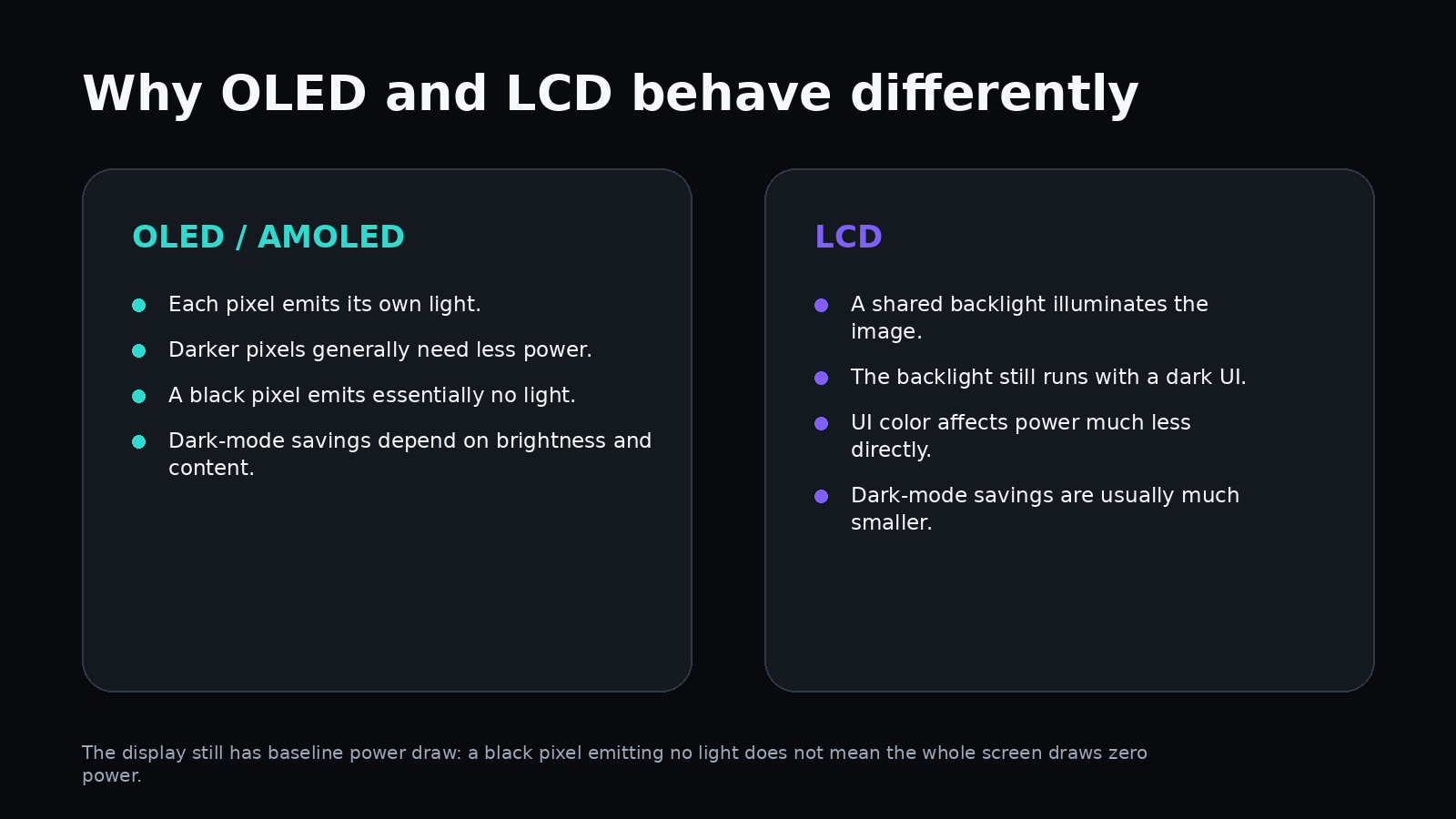
Dark mode is therefore most relevant as an energy-saving technique on OLED/AMOLED displays.
What the measurements found
The Purdue study tested Google Maps, Google News, Google Phone, Google Calendar, YouTube, and Calculator on the Pixel 2, Moto Z3, Pixel 4, and Pixel 5 — all OLED devices.
At 30–50% brightness, switching from light mode to dark mode saved roughly 3–9% of total phone power in the tested scenarios.
At 100% brightness, the range increased to roughly 39–47%.
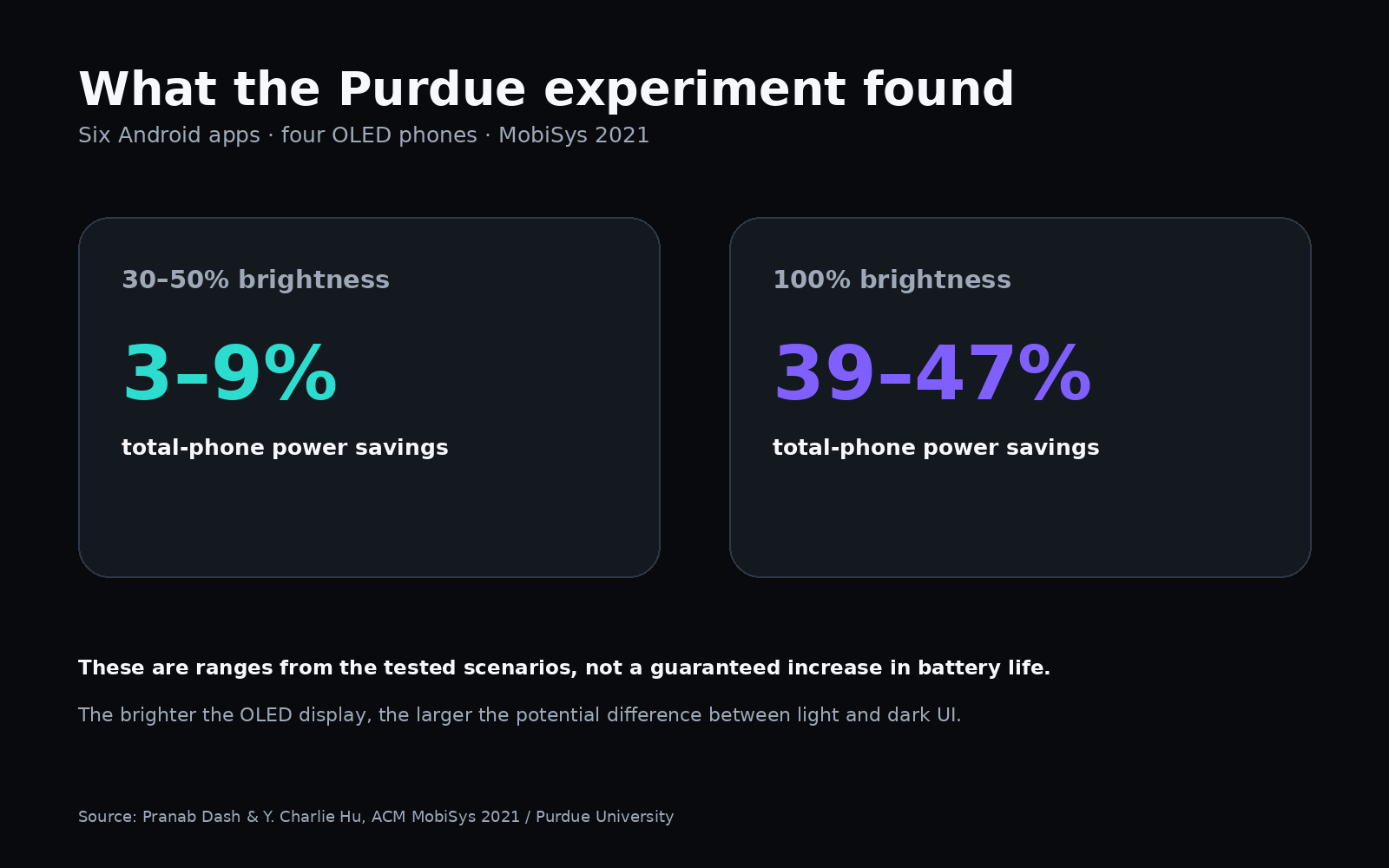
That does not mean dark mode guarantees 47% longer battery life. The study percentages are best read as reductions in phone power under the measured scenarios, not as universal increases in runtime per charge.
Why brightness changes the result so much
At low brightness, a bright OLED UI already uses relatively little display power. Darkening it reduces that draw further, but the absolute difference is smaller.
At high brightness, a large white area requires many OLED pixels to emit strongly. Replacing much of that area with dark pixels can produce a much larger reduction in display power.
That is why the Purdue results differ so sharply between 3–9% at moderate brightness and 39–47% at maximum brightness.
Why 39–47% does not mean 39–47% longer battery life
A smartphone also spends energy on the CPU and GPU, cellular radios, Wi‑Fi and Bluetooth, GPS, cameras, storage, sensors, background processes, and the operating system.
If the screen is a major part of the power budget at that moment, reducing display power can strongly affect the total. If the screen is off, the UI theme has no effect at all.
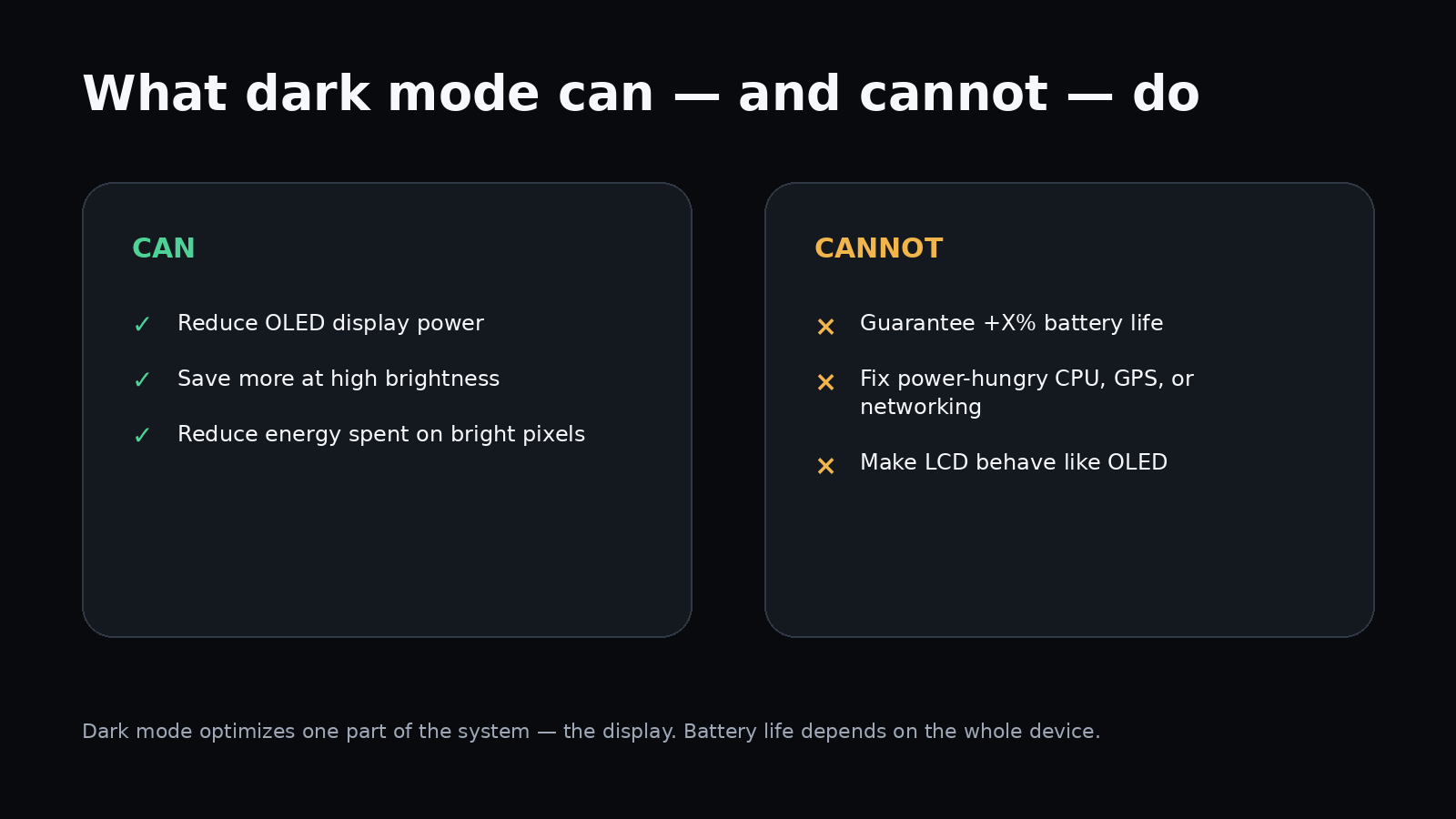
The technically accurate statement is: dark mode can reduce OLED display power and therefore reduce total device power. How much that translates into real battery-life extension depends on the workload.
Does the background have to be pure black?
No.
On OLED, #000000 does minimize light emission from those pixels. But pure black can make surface boundaries harder to distinguish, create very high contrast with white text, make visual hierarchy harder to express, or simply conflict with a product’s design system.
Android describes dark theme in terms of dark surfaces and lower luminance rather than requiring every surface to be absolute black.
Which matters more: dark mode or brightness?
Brightness is one of the dominant factors in OLED display power. The Purdue work shows that dark-mode savings become substantially larger as brightness rises.
In everyday use, lowering brightness can often matter more than switching the theme alone. That does not make dark mode irrelevant: the two effects work together.
OLED + high brightness + large bright surfaces is where dark mode has the greatest energy-saving potential.
What this means for LUNEVON
LUNEVON applications use dark interfaces first as a design-system choice: technical data, charts, indicators, and accents need to remain readable and visually coherent.
On OLED, that choice has an additional physical benefit: dark surfaces can reduce display power.
But it would not be responsible to turn that into a promise such as “LUNEVON dark UI extends battery life by X%.” There is no honest universal percentage without specifying the device, display brightness, screen content, and workload.
A more accurate statement is: a dark UI can reduce OLED display power. The higher the brightness and the more bright surface it replaces, the larger the potential effect.
Conclusion
Dark mode really can save energy, but its effect cannot be summarized by one number.
- On OLED/AMOLED, darker pixels generally require less power.
- On LCD, the shared backlight still runs, so the benefit is much smaller.
- Brightness strongly affects the size of the savings.
- At 30–50% brightness, Purdue observed roughly 3–9% total-phone power savings.
- At 100% brightness, the tested scenarios reached roughly 39–47%.
- Those percentages are not guaranteed battery-life extensions.
- Dark mode cannot compensate for high CPU, GPS, networking, or other system loads.
So the answer to the title is: yes, dark mode can save battery — especially on OLED and especially at high brightness. But it is a display optimization, not a universal battery-life switch.
Method and limitations
This article does not present Purdue’s measurements as original LUNEVON LABS data. The 3–9% and 39–47% figures come from Dash & Hu (MobiSys 2021) and apply to the four OLED phones and six Android apps they tested.
We do not generalize OLED results to LCD, and we do not treat scenario-level power reductions as direct predictions of battery runtime.
Sources
- Android Developers — Implement dark theme
- Purdue University — Dark mode may not save your phone’s battery life as much as you think, but there are a few silver linings
- Pranab Dash, Y. Charlie Hu — How Much Battery Does Dark Mode Save? An Accurate OLED Display Power Profiler for Modern Smartphones, ACM MobiSys 2021
- Android Developers — Themes