 LUNEVON

The latest Android major version is Android 17, which uses API level 37. Google released Android 17 on June 16, 2026 and made the source available through AOSP. This page is LUNEVON’s evergreen Android versions reference: it maps Android releases to API levels, names or platform codenames, and release dates, and explains what “latest,” “current,” and “supported” actually mean.
Android 17 is the latest major release. Quarterly Platform Releases, security patches, Google Play system updates, and minor SDK releases can update parts of the platform without creating a new major Android version.
Quick links: Version list · Latest version · API levels · Version names · Supported versions
Android versions list
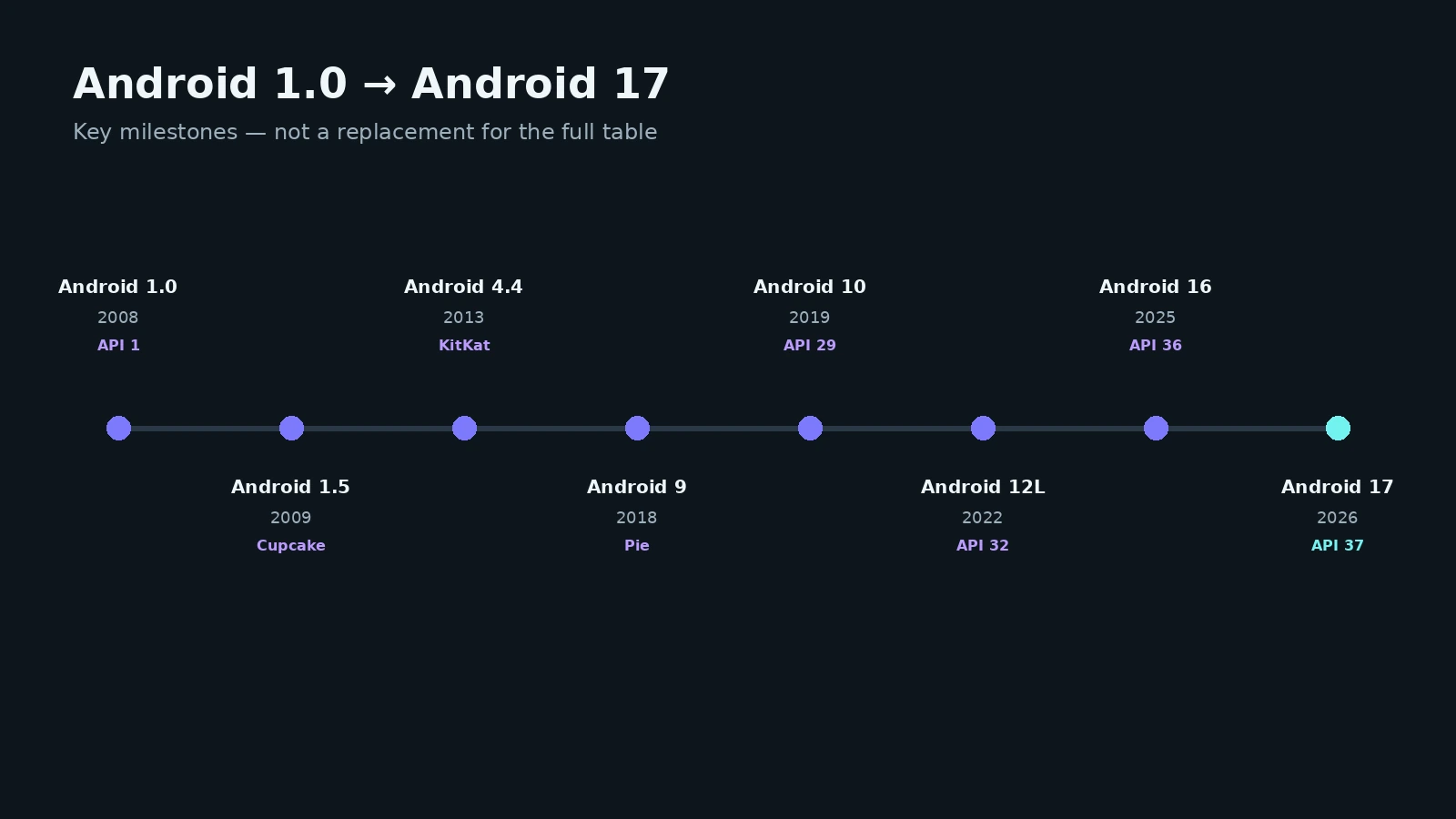
The table below is the core reference. It covers Android 1.0 through Android 17, including API-level-specific releases such as Android 12L and the Android 16 QPR2 minor SDK release.
Release date convention: the date column uses the official platform/AOSP/final-SDK release or first official public platform availability date used by this reference. A device manufacturer’s rollout date can be later.
| Android version | API level | Name / codename | Release date | Context |
|---|---|---|---|---|
| Android 17 | 37 | Cinnamon Bun | Latest major | |
| Android 16 QPR2 | 36.1 | Baklava / minor SDK | Minor SDK release | |
| Android 16 | 36 | Baklava | Earlier major | |
| Android 15 | 35 | Vanilla Ice Cream | Earlier major | |
| Android 14 | 34 | Upside Down Cake | Earlier major | |
| Android 13 | 33 | Tiramisu | Earlier major | |
| Android 12L | 32 | S_V2 | Large-screen feature drop | |
| Android 12 | 31 | S | Earlier platform release | |
| Android 11 | 30 | R | Earlier platform release | |
| Android 10 | 29 | Q | Earlier platform release | |
| Android 9 | 28 | Pie | Earlier platform release | |
| Android 8.1 | 27 | Oreo | Earlier platform release | |
| Android 8.0 | 26 | Oreo | Earlier platform release | |
| Android 7.1 | 25 | Nougat | Earlier platform release | |
| Android 7.0 | 24 | Nougat | Earlier platform release | |
| Android 6.0 | 23 | Marshmallow | Earlier platform release | |
| Android 5.1 | 22 | Lollipop | Earlier platform release | |
| Android 5.0 | 21 | Lollipop | Earlier platform release | |
| Android 4.4W | 20 | KitKat for Wearables | Wear-specific API level | |
| Android 4.4 | 19 | KitKat | Earlier platform release | |
| Android 4.3 | 18 | Jelly Bean | Earlier platform release | |
| Android 4.2 | 17 | Jelly Bean | Earlier platform release | |
| Android 4.1 | 16 | Jelly Bean | Earlier platform release | |
| Android 4.0.3 | 15 | Ice Cream Sandwich | Earlier platform release | |
| Android 4.0 | 14 | Ice Cream Sandwich | Earlier platform release | |
| Android 3.2 | 13 | Honeycomb | Tablet-era platform release | |
| Android 3.1 | 12 | Honeycomb | Tablet-era platform release | |
| Android 3.0 | 11 | Honeycomb | Tablet-era platform release | |
| Android 2.3.3 | 10 | Gingerbread | Earlier platform release | |
| Android 2.3 | 9 | Gingerbread | Earlier platform release | |
| Android 2.2 | 8 | Froyo | Earlier platform release | |
| Android 2.1 | 7 | Eclair | Earlier platform release | |
| Android 2.0.1 | 6 | Eclair | Earlier platform release | |
| Android 2.0 | 5 | Eclair | Earlier platform release | |
| Android 1.6 | 4 | Donut | Earlier platform release | |
| Android 1.5 | 3 | Cupcake | Earlier platform release | |
| Android 1.1 | 2 | — | Early platform release | |
| Android 1.0 | 1 | — | Initial Android release |
The context column is not a universal verdict on security support, OEM updates, or app compatibility.
The mapping is intentionally more precise than a simple “Android 12 = API 31” list. Android 12L has API level 32, and Android 16 QPR2 introduced the first released minor SDK level, 36.1. For normal app manifest compatibility, the major API level remains the key integer; minor SDK releases are a newer layer of the platform model.
Android 17
Android 17 is the latest major Android release as of this page’s last review on October 4, 2026. It was released on June 16, 2026 and uses API level 37. The official Android SDK constant is CINNAMON_BUN.
Android 17 QPR builds can add fixes and platform improvements after the initial release, but a QPR does not become “Android 18.” The major version remains Android 17 until the next major Android release.
Android 16
Android 16 was released on June 10, 2025 and uses API level 36. Its SDK codename is BAKLAVA.
Android 16 is also important because it introduced Android’s new major/minor SDK release model. Android 16 QPR2, released later in 2025, is represented by API level 36.1 in AOSP’s release-family table. That is a minor SDK release, not Android 17.
Android 15
Android 15 uses API level 35 and the SDK codename VANILLA_ICE_CREAM. Google released its source to AOSP on September 3, 2024; supported-device rollouts followed on their own schedules.
Android 14
Android 14 was released to AOSP on October 4, 2023. It maps to API level 34 and uses the SDK codename UPSIDE_DOWN_CAKE.
What is the latest Android version?
As of October 4, 2026, the latest Android major release is Android 17 (API level 37).
| Term | What it means |
|---|---|
| Latest major Android | The newest numbered platform generation: Android 17 |
| QPR | A quarterly platform update inside an existing major release |
| Minor SDK release | A platform release that can add APIs without creating a new major Android number |
| Security patch | Security fixes represented by a patch level/date |
| Google Play system update | Modular system components delivered separately from a full OS upgrade |
A phone can therefore be fully on Android 17 while receiving newer QPR or security updates. Those updates do not automatically change the major version label.
Android version vs API level
An Android version and an API level are related, but they are not the same number.
Android 17 is the user-facing operating-system generation. API level 37 identifies the major Android framework API revision exposed to applications and developers.
| Android version | API level |
|---|---|
| Android 17 | 37 |
| Android 16 | 36 |
| Android 15 | 35 |
| Android 14 | 34 |
| Android 13 | 33 |
| Android 12L | 32 |
| Android 12 | 31 |
| Android 11 | 30 |
| Android 10 | 29 |
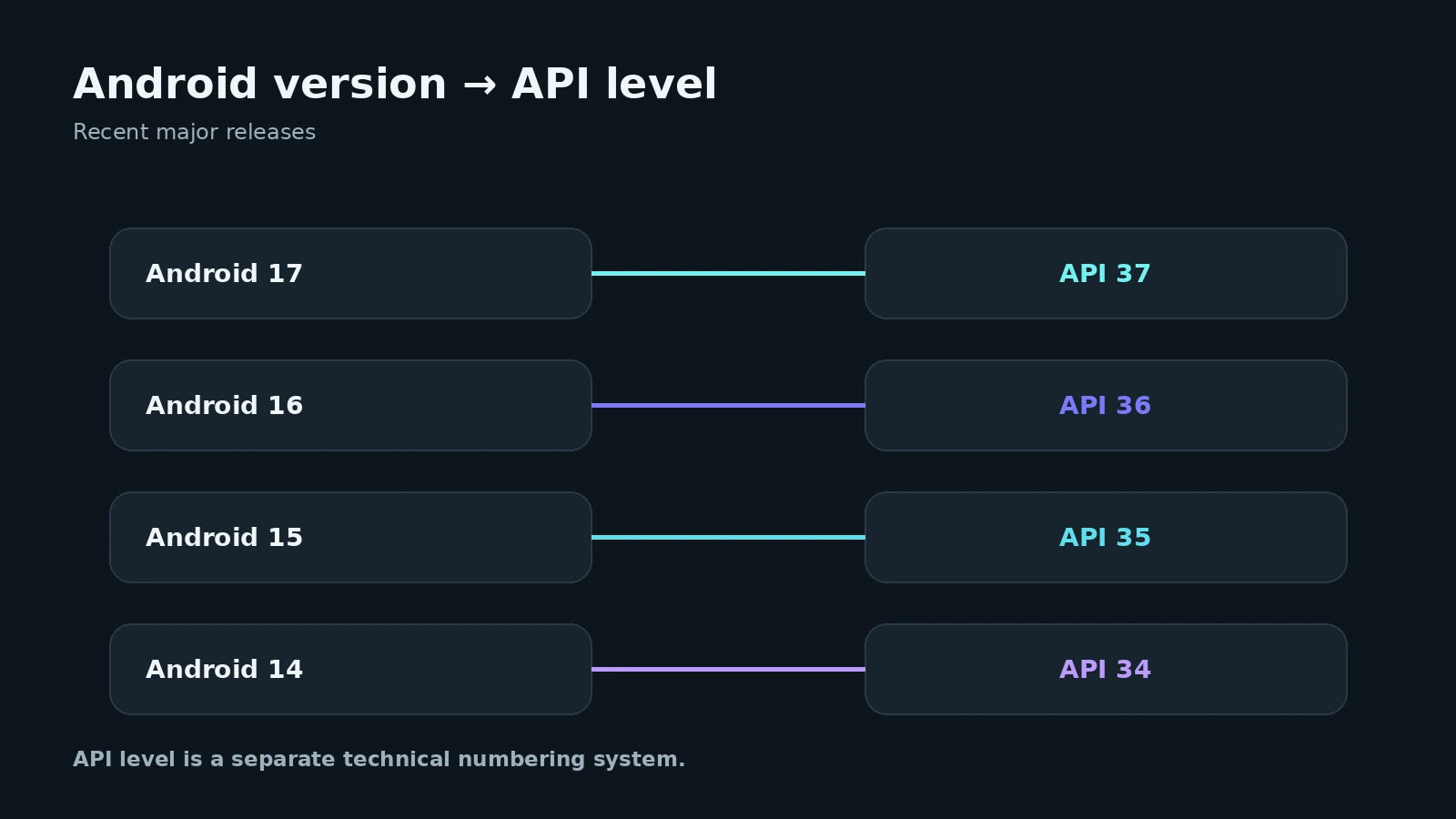
The API level is not calculated from the Android version number. Android’s own documentation describes API level as an integer that uniquely identifies a framework API revision.
The Android 16 minor-SDK model adds another nuance: a release such as Android 16 QPR2 can be represented as 36.1 in the full SDK version model while the major SDK_INT remains 36.
Android API / SDK versions
Search results often mix “Android SDK version,” “API version,” and “Android version.” They are connected, but developer settings have different jobs.
API level describes the platform framework revision, such as API 37 for Android 17. compileSdk tells the build system which Android API set the app is compiled against. targetSdk declares the Android API level whose behavior changes the app is designed and tested to target. minSdk declares the minimum Android API level on which the app can be installed.
These values belong to application development and should not be mistaken for the Android version installed on a user’s phone. An app can be compiled with a newer compileSdk, target API 37, and still support lower Android versions if its minSdk allows it and compatibility is handled correctly.
This page intentionally does not cover Android Studio, Android Gradle Plugin, Gradle, or Kotlin plugin versions. Those are developer-tooling versions, not Android platform versions.
Android version names and codenames
Android’s naming system has changed over time.
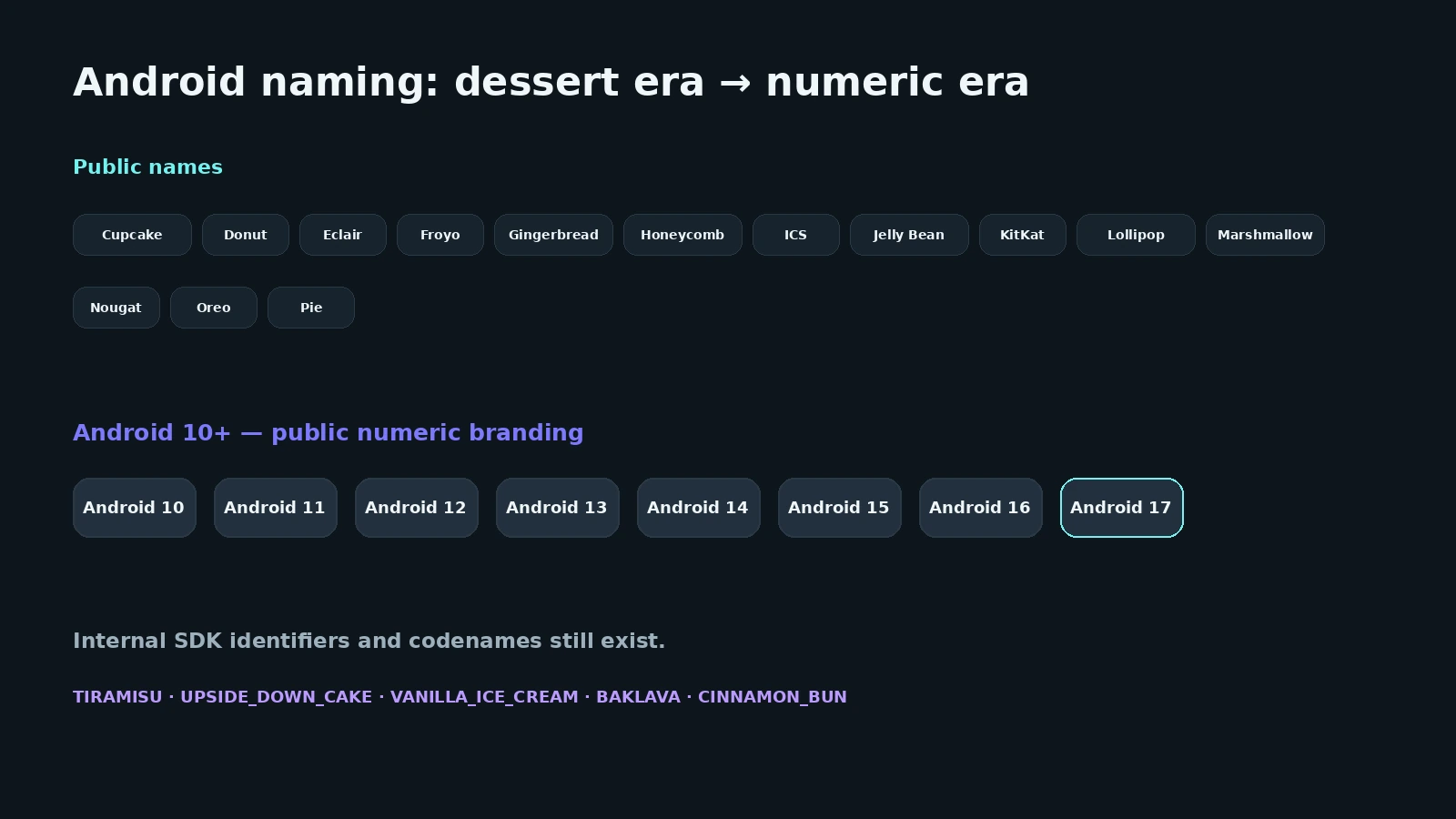
From Android 1.5 through Android 9, public releases became strongly associated with dessert names:
Cupcake → Donut → Eclair → Froyo → Gingerbread → Honeycomb → Ice Cream Sandwich → Jelly Bean → KitKat → Lollipop → Marshmallow → Nougat → Oreo → Pie
Starting with Android 10, Google changed the public-facing branding to simple version numbers. That did not eliminate internal platform identifiers. Official Android SDK documentation continues to expose version-code names or codenames, for example Q, R, S, S_V2, TIRAMISU, UPSIDE_DOWN_CAKE, VANILLA_ICE_CREAM, BAKLAVA, and CINNAMON_BUN.
The practical rule is simple: the numbered Android version is the user-facing reference; the codename is useful historical or developer context.
Android version history
Android’s release history is easier to understand as a few broad phases than as dozens of isolated stories.
Android 1.0–1.1: the base platform
Android 1.0 launched in 2008 with API level 1. Android 1.1 followed with API level 2. AOSP’s current release-family reference lists these early releases without public dessert codenames.
Cupcake to Gingerbread: rapid phone-platform expansion
Android 1.5 Cupcake began the familiar dessert naming sequence. Donut, Eclair, Froyo, and Gingerbread followed quickly as Android expanded device, display, multimedia, networking, and application capabilities.
Honeycomb and Ice Cream Sandwich: tablets and reunification
Android 3.x Honeycomb was a tablet-focused branch with API levels 11–13. Android 4.0 Ice Cream Sandwich then reunited phone and tablet platform direction under one release family.
Jelly Bean to Pie: mature dessert-era Android
Jelly Bean, KitKat, Lollipop, Marshmallow, Nougat, Oreo, and Pie cover a long period in which Android’s public releases were widely identified by dessert names as well as version numbers.
Android 10 and later: numbered public releases
Android 10 switched the public brand to a numeric naming scheme. The modern release model has also become more nuanced: Android 12L introduced a distinct API level inside the Android 12 generation, and Android 16 established a formal minor SDK release model alongside the annual major release.
Which Android versions are supported?
There is no single honest universal “supported Android versions” list without first defining supported by whom and for what.
Platform / AOSP status: a release can exist in AOSP with an official API level and source history. That does not promise that every device running it still receives updates.
OEM and device support: manufacturers define update periods for specific models. Two phones on the same Android version can have different remaining support lifetimes.
Security ecosystem: the Android major number alone does not describe the entire security state. Patch level, vendor components, kernel, modular updates, and manufacturer policy all matter.
App support: each app defines its own minimum supported API level. One app can drop a version of Android while another still supports it.
For that reason, the version table uses release context rather than a simplistic supported/unsupported flag.
Latest vs current vs supported Android
| Term | Best interpretation |
|---|---|
| Latest Android version | Newest released major platform version |
| Current Android version | Ambiguous: latest globally or the version currently installed on a device |
| Newest Android version | Usually the latest major release |
| Supported Android version | Requires context: device, OEM, security program, or app |
| API level | Technical framework revision, not a support verdict |
As of the current review, Android 17 is the latest major Android version. Whether Android 17, 16, 15, or an older release is supported on a specific phone is a separate device-support question.
How to check your Android version
To find the Android version installed on a phone, open Settings and look for About phone, About device, or Software information. The exact menu varies by manufacturer.
For a full practical walkthrough, see How to check your Android version, build number and API level. If you also need the processor, RAM, storage, display, battery, and other device specifications, see How to check Android phone specifications.
FAQ
What is the latest Android version?
As of October 4, 2026, the latest major Android release is Android 17, which uses API level 37. Google released Android 17 on June 16, 2026.
Why has my phone not received the latest Android release?
Manufacturers distribute Android updates according to device model, region and support policy. A new platform release does not mean that every phone receives it immediately.
What API level is Android 17?
Android 17 is API level 37.
What API level is Android 16?
The Android 16 major release is API level 36. Android 16 QPR2 introduced a minor SDK release represented as 36.1 in the full SDK version model.
What is the difference between Android version and API level?
Android version is the user-facing platform generation, while API level identifies a framework API revision. They map to each other, but the numbers are not the same.
What are the Android version names?
Public dessert names ran from Cupcake through Pie. Android 10 and later use numbered public names, while official SDK identifiers and internal codenames still exist.
Which Android versions are still supported?
There is no universal answer. OEM/device updates, security maintenance, and app compatibility use different support rules, so support must be checked for a specific context.
Is Android SDK version the same as Android version?
No. Android version identifies the operating-system release. API level and SDK settings such as compileSdk, targetSdk, and minSdk are developer-facing compatibility and build values.
How do I check my Android version?
Open Settings and find About phone, About device, or Software information. For a detailed explanation, use the dedicated LUNEVON version-check Guide.
Sources and documentation
This reference prioritizes primary Android sources:
- Android Developers — API levels and platform versions
- Android Open Source Project — codenames, release families and build tags
- Android Developers — Android 17
- Android Developers Blog — Android 17 is here
- Android Developers Blog — Android 16 is here
- Android Developers Blog — Android 16 QPR2 is released
- Android Developers Blog — Android 15 released to AOSP
- Android Developers Blog — Android 14 live in AOSP
- Android Developers Blog — Android 13 in AOSP
- Android Developers Blog — Android 12 live in AOSP
- Android Developers Blog — Android 11 final release
- Android Developers Blog — Android 10
shared/android_versions.json in the publication package is the source-of-truth for the version table and latest-version fields.